

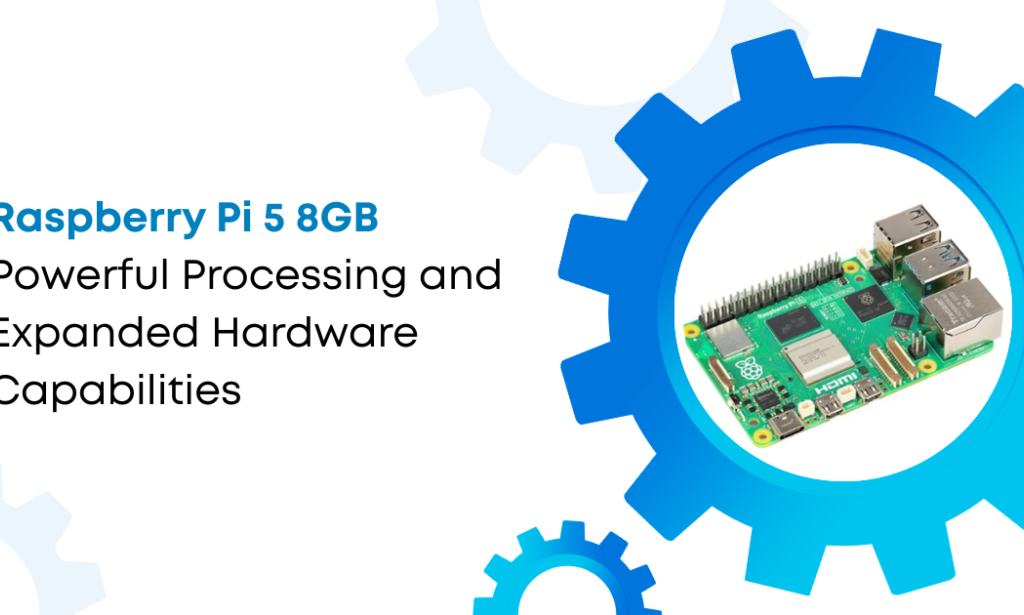
Single-board computers have changed modern computing. Engineers, students, and hobbyists use them for experiments and real products. These devices offer compact size and low power use. The Raspberry Pi 5 8GB represents a major step in this product line. The board provides faster processing, better graphics, and improved hardware connections. These upgrades help developers build advanced systems on a small platform.
Earlier Raspberry Pi models focused on education and small projects. The Raspberry Pi 5 targets heavier workloads. Developers can run complex software, multimedia systems, and edge computing tasks.
This article explains the hardware improvements and technical capabilities of the Raspberry Pi 5 8GB. It also describes real-world applications and performance benefits.
Overview of Raspberry Pi 5
The Raspberry Pi Foundation designed the Raspberry Pi series to support learning and experimentation. Over time, these boards evolved into capable development platforms. The Raspberry Pi 5 continues this progress with several hardware upgrades. The board includes a faster processor, improved memory speed, and new connectivity features.
Main Specifications
Key hardware specifications include:
-
Quad-core ARM Cortex-A76 CPU
-
2.4 GHz clock speed
-
8GB LPDDR4X RAM
-
VideoCore VII graphics processor
-
Dual micro-HDMI ports
-
PCIe expansion interface
-
Gigabit Ethernet
-
Dual-band Wi-Fi
-
Bluetooth 5.0
-
Two USB 3.0 ports
-
Two USB 2.0 ports
-
40-pin GPIO header
Processor Architecture and Performance
1. ARM Cortex-A76 CPU
The most important upgrade in the Raspberry Pi 5 8GB is the processor architecture. The board uses a quad-core ARM Cortex-A76 CPU. Each core runs at up to 2.4 GHz. This architecture improves instruction execution and pipeline efficiency.
Older Raspberry Pi models used Cortex-A72 processors. The new design offers higher instructions per clock.
-
CPU Cache Structure: The processor features multiple cache layers, including 512 KB L2 cache per core and a 2 MB shared L3 cache. This cache memory reduces data access latency, allowing programs to run faster when frequently used information is stored closer to the CPU.
-
Performance Statistics: Benchmark tests reveal that the Raspberry Pi 5’s CPU delivers roughly double the performance of the Raspberry Pi 4. Integer workloads run 80–100% faster, and compilation tasks, such as building Linux kernels or large software projects, complete significantly more quickly.
Memory Architecture and Capacity
1. 8GB LPDDR4X Memory
The Raspberry Pi 5 8GB includes 8GB of LPDDR4X RAM. This memory type provides higher bandwidth and lower power usage. Memory speed reaches about 4267 MT/s. This speed nearly doubles the memory bandwidth of older Raspberry Pi boards.
Advantages of Higher Memory Bandwidth
Higher bandwidth improves several computing tasks:
-
Database operations
-
Multitasking workloads
-
Data processing
-
AI model inference
2. Desktop Usage Benefits
Users who run Linux desktop environments benefit from the 8GB configuration.
Common tasks include:
-
Running multiple browser tabs
-
Compiling code
-
Editing media files
-
Running programming tools
Graphics and Multimedia Performance
1. VideoCore VII GPU
The Raspberry Pi 5 introduces a new graphics processor called VideoCore VII. This GPU improves rendering performance and multimedia capabilities.
Key features include:
-
OpenGL ES 3.1 support
-
Vulkan graphics compatibility
-
Hardware video decoding
-
Better graphics pipeline efficiency
2. Video Playback Capability
The board supports 4K video decoding using hardware acceleration. Video playback remains smooth even with high-resolution media.
This capability benefits several applications:
-
Digital signage systems
-
Media centers
-
Smart displays
-
Video streaming devices
Dual 4K Display Support
The Raspberry Pi 5 supports two 4K monitors at 60 Hz. Earlier models could support dual displays but at lower refresh rates. Higher refresh rates improve user experience in desktop environments. Developers can build multi-screen dashboards or monitoring systems.
Example Applications
Dual displays help in several situations:
-
Control rooms
-
Industrial monitoring
-
Trading dashboards
-
Programming environments
Users can place development tools on one screen and documentation on another.
PCIe Expansion Capability
1. Introduction of PCIe Interface
One major improvement in the Raspberry Pi 5 is the PCI Express expansion interface. Earlier models lacked direct PCIe connectivity. Developers relied on USB adapters. The Raspberry Pi 5 provides PCIe 2.0 x1 connectivity.
2. Data Transfer Speed
PCIe 2.0 provides theoretical bandwidth near 5 gigatransfers per second. Practical data rates reach about 450 MB per second. This speed allows fast communication with external devices.
3. Hardware Expansion Options
PCIe enables several new hardware possibilities:
-
NVMe SSD storage
-
AI accelerator modules
-
High-speed network cards
-
Data acquisition hardware
For example, an NVMe SSD can improve storage performance by several times compared with microSD cards.
USB and Peripheral Connectivity
1. USB Ports
The Raspberry Pi 5 provides four USB ports:
-
Two USB 3.0 ports
-
Two USB 2.0 ports
USB 3.0 ports support transfer speeds up to 5 Gbps. These ports allow connection to fast storage devices and peripherals.
2. Peripheral Support
Common peripherals include:
-
External SSD drives
-
Cameras
-
Keyboards and mice
-
Microcontrollers
-
Sensors
USB connectivity helps developers build complex systems quickly.
Networking Capabilities
1. Wired Networking
The board includes Gigabit Ethernet. Gigabit Ethernet supports network speeds up to 1000 Mbps. This speed allows reliable data transfer for servers and network tools. Developers often use Raspberry Pi boards for network monitoring.
2. Wireless Connectivity
The Raspberry Pi 5 also supports wireless communication.
Wireless features include:
-
Dual-band Wi-Fi
-
Bluetooth 5.0
Wi-Fi supports 2.4 GHz and 5 GHz networks. Bluetooth allows wireless peripherals and IoT sensors.
3. IoT Gateway Applications
Networking features make the board useful for IoT gateways.
Example tasks include:
-
Sensor data collection
-
Smart home control
-
Edge computing nodes
Power Consumption and Cooling
1. Power Requirements
Higher performance requires more power. The Raspberry Pi 5 uses a USB-C power connector.
Typical power recommendations include:
-
5V / 3A supply for basic use
-
5V / 5A supply for heavy workloads
Peak power consumption can reach about 12 watts during heavy processing.
2. Thermal Management
Higher processing power generates more heat. Proper cooling prevents performance reduction.
Cooling solutions include:
-
Heat sinks
-
Active cooling fans
-
Dedicated Raspberry Pi cooling modules
Active cooling helps maintain full CPU speed during long workloads.
Real-World Applications
The Raspberry Pi 5 8GB supports many practical uses. Its performance enables more demanding workloads than earlier models.
1. Edge Artificial Intelligence
The Raspberry Pi 5 8GB enables edge AI processing close to the data source. Developers can run optimized models for tasks like object detection, industrial inspection, and smart traffic monitoring, processing images in tens of milliseconds with lightweight, efficient AI applications.
2. Robotics Systems
Robotics projects benefit from the Pi’s computing power and GPIO access for sensor processing and motor control. Applications include autonomous robots, drones, warehouse automation, and research robots, often paired with motor drivers and sensors to create fully functional robotic systems.
3. Home Servers
he Raspberry Pi 5 can host multiple server services, including media streaming, personal cloud storage, network file servers, and backups. PCIe NVMe storage enhances speed, making it a practical choice for compact home servers requiring reliable, efficient performance.
4. Development and Education
Raspberry Pi devices are widely used in education for teaching programming, electronics, and system design. Popular languages include Python, C++, JavaScript, and Rust. Universities also deploy Pi boards in research labs to explore computing experiments and prototype projects.
Comparison with Previous Raspberry Pi Models
Hardware improvements become clear when comparing the Raspberry Pi 5 with older models.
|
Feature |
Raspberry Pi 4 |
Raspberry Pi 5 |
|
CPU |
Cortex-A72 |
Cortex-A76 |
|
Clock Speed |
1.8 GHz |
2.4 GHz |
|
GPU |
VideoCore VI |
VideoCore VII |
|
PCIe Support |
No |
Yes |
|
Memory Speed |
~2000 MT/s |
4267 MT/s |
|
Dual Display |
4K30 |
4K60 |
Limitations and Design Considerations
Despite its improvements, the Raspberry Pi 5 still has certain limitations.
1. Storage Speed
Although improved, the Raspberry Pi 5 still relies on microSD storage by default, which is slower than SSDs. Developers often add NVMe drives via PCIe adapters to boost read and write speeds, improving performance for demanding storage tasks.
2. Cooling Requirements
Heavy workloads generate significant heat, so active cooling is recommended for the Raspberry Pi 5. Without proper cooling, thermal throttling can occur, reducing CPU performance and slowing intensive tasks, making cooling a crucial design consideration for sustained high-performance use.
3. Limited PCIe Lanes
The Raspberry Pi 5 includes only one PCIe lane, limiting bandwidth for high-performance peripherals. While sufficient for most projects, this constraint affects certain storage devices, GPUs, or high-speed expansion cards, requiring careful planning for advanced hardware setups.
4. Overall Considerations
Despite these limitations, the Raspberry Pi 5 remains a highly capable board, delivering excellent CPU performance, efficient caching, and versatile real-world applications, making it suitable for AI, robotics, home servers, and educational projects, provided its constraints are managed effectively.
Future Outlook
The Raspberry Pi ecosystem continues to grow. Hardware manufacturers now produce expansion boards, sensors, and AI accelerators. These add-ons extend the capabilities of the Raspberry Pi 5. Edge computing, robotics, and smart infrastructure will likely use this platform more often. Small computing systems now handle tasks that required full computers in the past.
Conclusion
The Raspberry Pi 5 8GB represents a major improvement in the Raspberry Pi family. The board introduces a faster Cortex-A76 processor, improved graphics, and higher memory bandwidth. These upgrades double the processing performance compared with earlier models. New hardware capabilities also expand the system’s potential. The addition of PCIe connectivity allows fast storage and specialized hardware modules. Dual 4K display support improves desktop usability. Improved networking enables server and IoT applications. Developers, engineers, and researchers now use the Raspberry Pi 5 for demanding tasks. These tasks include robotics, AI inference, data processing, and home server systems. The board remains compact, affordable, and flexible. This combination makes it one of the most powerful single-board computers currently available.

You must be logged in to post a comment.